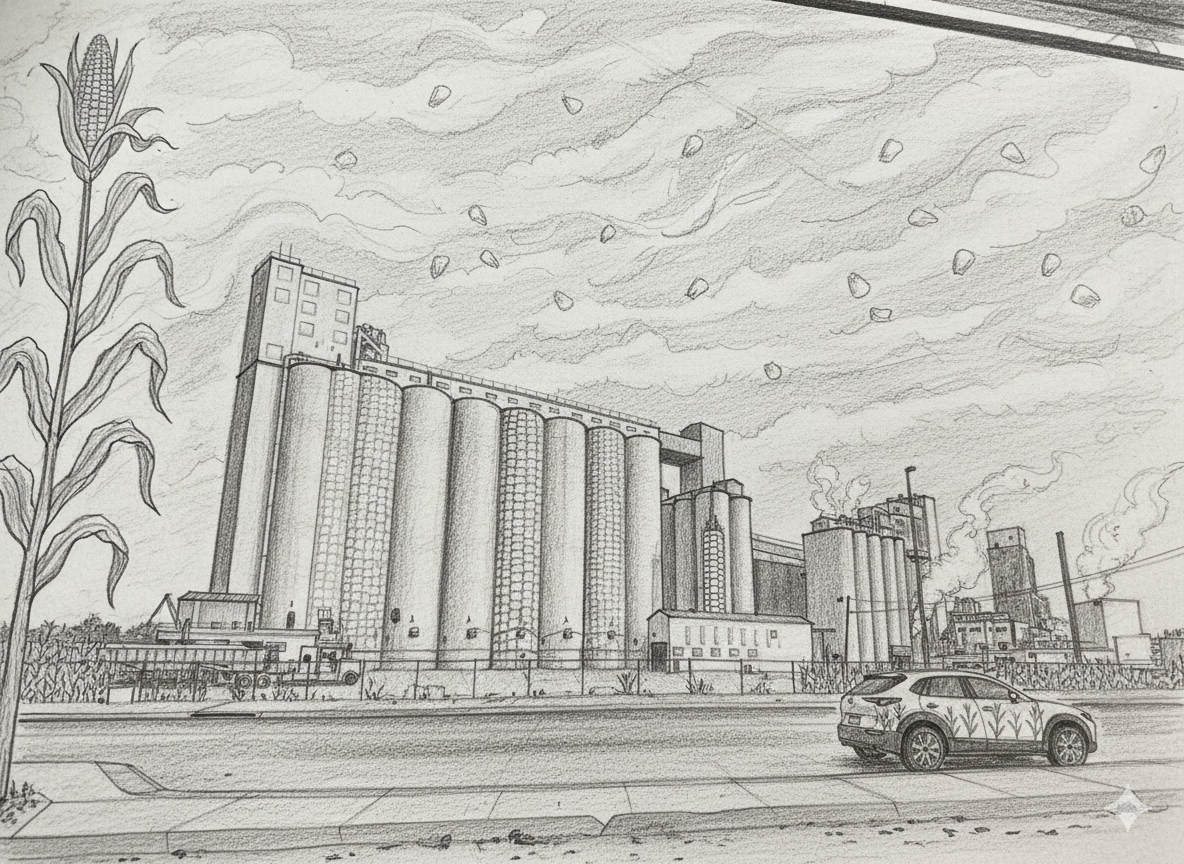
The other day my boys and I were driving through a nearby town. We saw a giant grain bin compound alongside the traintracks, and the boys asked me about. While I knew it was some sort of corn processing plant, I had no idea – so I snapped a picture, gave it some details, and asked an AI chatbot to give me a virtual tour.
I was very pleasantly surprised at the walkthrough – and it was an ever-relevant reminder of how amazingly irrational our food system is.
Historically, industrialization was touted as a massive benefit for humanity. Interchangeable parts allowed us to build products that could be repaired quickly, cheaply, and universally. Reliable. Scaleable. Efficient.
It would appear, however, that the wheel of history has turned. Now, Industrialization is being heavily leveraged to the detriment of the average person – if you want that cheapo-but-necessary-custom-part – that’ll be $150, thanks so much.
Exhibit A: our little virtual corn mill tour (and yes, it turns out it is a corn mill – apparently, one of the world’s largest dry corn mills in the world). Chances are, if you’ve ever eaten anything in America with dry-corn ingredients (i.e. as opposed to corn syrup), you’ve eaten corn from this exact mill. And here’s what we learned:
Farmers grow various levels of consumable corn: feed corn (for livestock) and “flour corn” for human-eating.
Note that this mill is not a “wet mill” – wet mills take feed corn and turn it into ethanol, corn syrup, and industrial additives like adhesive or plastics. Want fries with that?
But this mill is a dry mill: it receives shipments of human-eating-grade corn (specially bred for higher starch content) via trucks or train, and essentially grinds the corn. However, there’s a wrinkle: as a grain, corn has a tough exterior shell (“hull”) that keeps bacteria out of the kernel – and therefore, away from the nutrients.
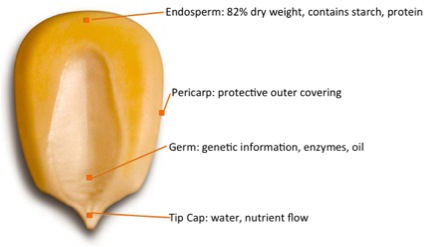
Now, if you don’t crack the kernel, that corn will last a very long time without spoiling. The bulk of nutritional value is in the germ and the oil – the remaining elements (the starch) is virtually non-nutritive sugar aka basic carbohydrates. However, there’s a problem: as soon as you grind this grain, bacteria gets access to the nutritious parts of the kernel. It’ll only last a few weeks before bacteria get the better of it and it starts to smell. (Quick note for reference: generally, bacteria doesn’t grow particularly well on bare sugar – in a lab, for example, you need a carb + nutrients, e.g. an agar plate, etc. Too much plain ol’ sugar and the bacteria die).
So naturally, like good industrialists, we simply remove the nutrients – no nutrients, no bacterial activity!
Like my kids, you may pose the obvious question: if it’s stripped of most of the nutrients, why would we want to eat it? And what about our gut own gut bacteria? Sit down and be quiet, why do you hate progress? Look there’s a squirrel!
If you’re grinding and processing corn at a massively-centralized location, selling product nationally (let alone globally), this strippage is a requirement – corn that has nutrients will spoil in a matter of weeks, and there’s simply no feasible way to process the corn, ship it to food processor factories to process into grocery products, ship it to grocery stores and wait for people to buy it, before the spoilage window closes. Now, if you were growing, selling, and eating food locally, that would be a different story… naw, that would be medieval.
But let’s flip back to our industrial corn mill. Because there’s more! Think about this: corn is yellow – at least, the hull and the oil are yellow. Corn tastes like… well, corn. But if you pull the oil and nutrients out, all that’s left is more or less tasteless white-gray starch. That’s not going to sell. You’ll need to add zip back into it – colors (usually artificial), tastes (natural or artificial), and even nutrients (not real corn-derived nutrients – cheap mimic nutrients, typically derived from petroleum synthesis). In other words, you stripped the life out of this living food – now, if you want anyone to buy it, you’ll need to convince them to believe that it’s basically the same thing, by adding fake sensory replacements. Now that’s nutrition!
Which leads me to ponder: we traced this deficit for corn. But the requisite corner-cutting that inherently comes with borderless food trade doesn’t only apply to corn: it applies to any and every living food that is processed, packaged, and sold within that system. Which means that no matter what you buy at the grocery store, your “tomato” will never actually be a robust tomato like the ones from your garden, your “chicken” will never be a bursting-with-life sunshine-fed animal like the ones from your neighbor – and your “corn” will never be found with it’s full living vitality nestled in a crinkly plastic package on the shelf. Organic; pasture raised; preservative free – doesn’t matter. If it’s in the grocery store, compromises were made.
I get it. I’ll still be going to the grocery store, for the time being. For now, we’re stuck in a irrational system proffered as “normal” by an irrational world. But thinking through these things helps. We’re working on it.